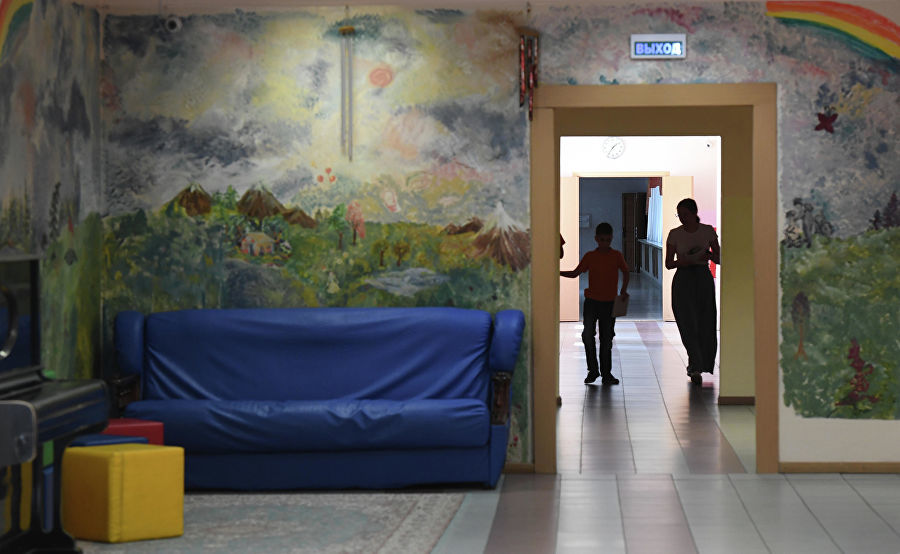
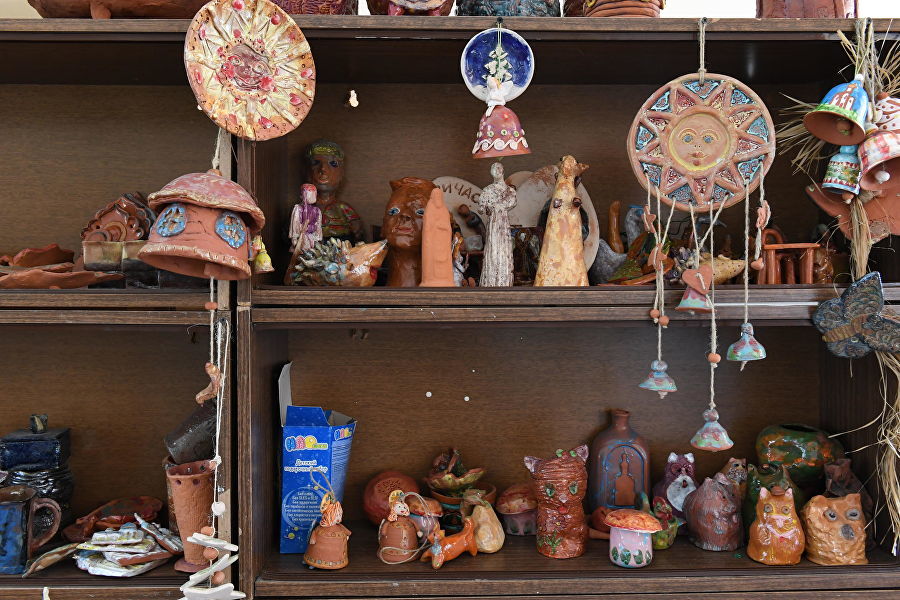
RIA Novosti has published a report about the wards of the Sergiev-Posad boarding house of the deaf-blind for children and young people with disabilities. The journalists did not just visit the institution - they conveyed the atmosphere in which young people are trained, for whom the lights went out and the sounds subsided ...
“Ba-la-ban”, - diligently, five-year-old Olya takes out in syllables and, as if wanting to make the speech even clearer, with her index fingers, she beats the imaginary drum with sticks. The girl never saw this musical instrument, did not hear its fraction.
Like most pupils of the Sergiev-Posad boarding school for deaf-blind children and young people with disabilities, it perceives the world only by touch. This is the only educational institution in Russia where people receive rehabilitation with a total loss of hearing and vision. How to teach a child living in complete darkness and silence, to understand this world - in the report of RIA Novosti.
Abrasive monday, fur sunday
Along the long corridors of the boarding school, children move only along the right side. They go, putting forward a hand. And necessarily they probe the walls. They have a different texture: some rooms are tiled, others are covered with textured paint. This is to ensure that blind pupils can navigate in space.
Here the girl in huge glasses walks along the wall. At the door, she stops, gropes on one of the shutters a bas-relief in the form of a rectangle - and dives into the opening. Such convex landmarks are everywhere: on individual lockers for clothes, on drawers where towels and toothbrushes are stored. Even the daily routine is explained to children with the help of three-dimensional pictures.
“A blind child, and even hearing impaired, cannot be taken by the hand and lead, say, to the dining room. He will not understand where he is being led, may show aggression. So that the pupil knows his daily routine, understands what needs to be done now, everyone has an individual calendar. The cards in the form of volumetric images depict one or another action: lunch, a walk, study, and preparation for bed, ”says Liliya Abdukamalova, deputy director of the boarding school for educational work.
On the bedside table is the calendar of Renat (the names of minors in the text are changed) - the boy does not see, but partially hears thanks to the hearing aid. On the first page of the calendar - the note icon. This means that at the moment the child wants to listen to music. Nearby, embracing the receiver does Renat sit. Further in the improvised diary of the boy, the image of a tree is according to the schedule for the group walk. Then a spoon - dinner, a toothbrush - preparation for bed, a pillow – bed-time.
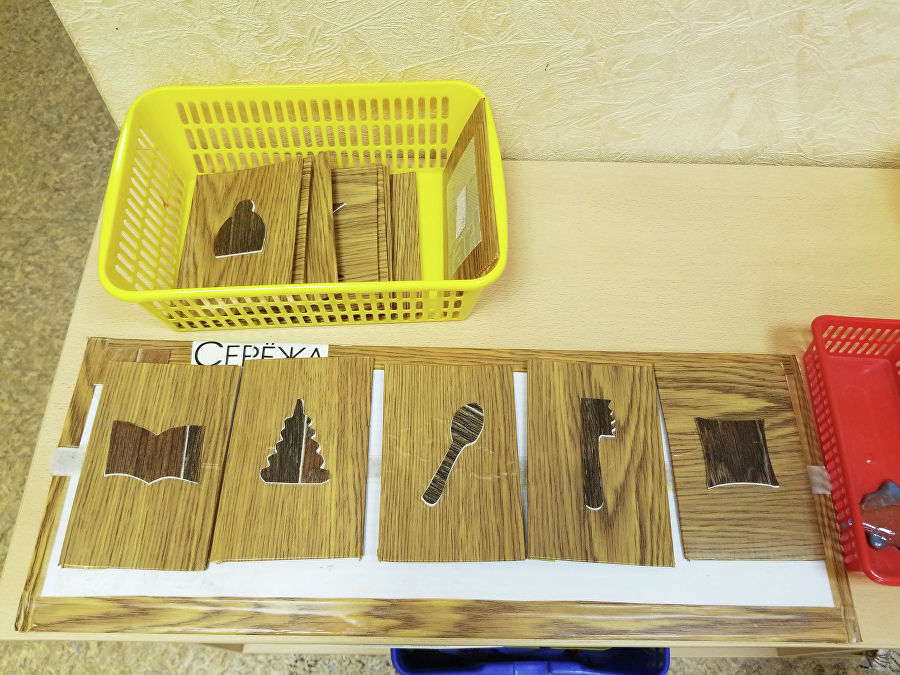
To explain to the children what the day of the week is, they also use a tactile calendar. Each cell has its own texture. Monday rough, like sandpaper. Tuesday - all in the pimples. Sunday is as soft as a piece of fur. As soon as the day passes, the square is removed. “It is difficult for a blind and deaf child to navigate not only in space but also in time. He, after all, does not see, how the day is replaced at night, as hands of hours move. So that the children understand that the week consists of seven days, we have created such a calendar, ”continues the headteacher.
Any abstract concept of blind and deaf children is given with difficulty. How, for example, to explain to a blind child what the sun is? To do this, on a walk, children place their hands and face under the sun's rays and feel: it has become warm. Then they are given to touch the bas-relief depicting the solar disk.
“We will definitely walk with the pupils in the rain, in the snow, with strong winds - the only way to tell about these weather phenomena.”
Totally blind and deaf people need to be taught even to experience the right emotions. “Healthy babies usually repeat everything after mom. For example, they went out, saw the first snow, the mother was delighted. Children copied this emotion. Henceforth, they will rejoice whenever the first snowfalls. But our pupils can scream, cry. They simply do not know how to react to this phenomenon correctly. Teachers teach them to do this according to a special methodology, the boarding school employees clarify.
To see by hands
In front of Alyona Kapustyan, a totally blind and deaf girl is a textbook on algebra for the ninth grade, printed in Braille. It is comparable in size to an album in art, in thickness - to the volume of “War and Peace”. But this is not even the whole textbook, only one of its seven parts. Mathematical symbols in Braille are written in fairly complex characters. The solution of the system of equations can take one or even one and a half pages.
Alyona has written five already. She is preparing for the OGE in mathematics - one of the most difficult subjects for the blind. When spatial thinking is absent, it is not easy to understand what the square root of a number is or how to calculate the area of a parallelepiped. But Alyona copes. Perhaps because she was not deafblind all her life. She lost her hearing at the age of two, her eyesight at six, after an unsuccessful operation.
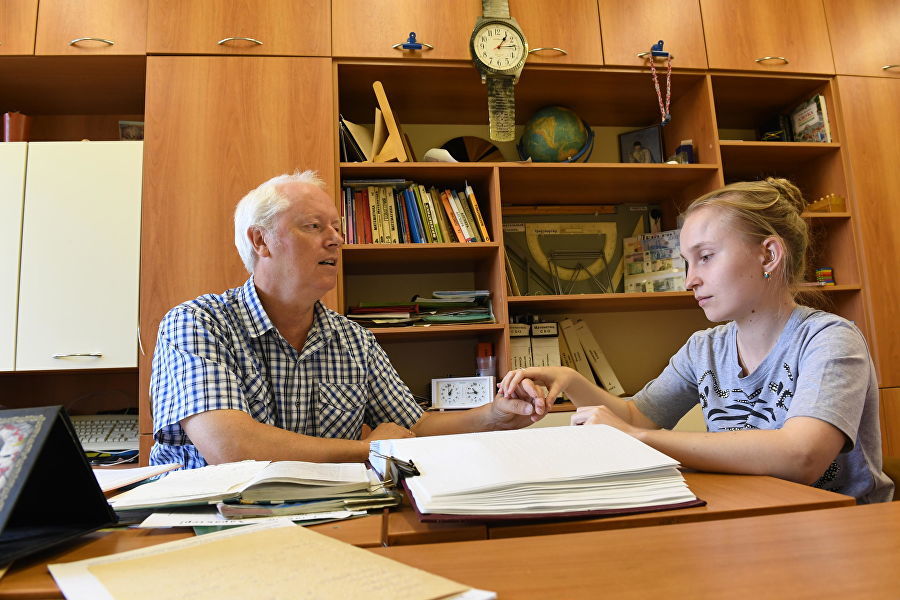
“She still remembers how the world looks around, knows the shape of letters. Therefore, I can write the most difficult terms to her on the palm of my hand - and she reads them, ”says teacher Vyacheslav Sheshnin.
But nevertheless, the teacher explains almost the entire school curriculum with the help of gestures. Alyona cannot see them - but she can feel. This is called "speak in hand." Vyacheslav Romanovich puts the girl’s palm on top of his and quickly begins to touch his fingers. "In this equation, X is equal to one," he translates for us.
For almost all totally deaf-blind, contact sign language is the only way to communicate. But not for Alyona. She learned to understand the speech of the interlocutor on the vibrations of the larynx.
The teacher puts Alyona's hand on her throat, asks how many years she has been studying at the boarding school.
"Thirteen. I entered at seven. Now I’m 20, ”although Alyona swallows some of the sounds, says quite clearly.
The girl even learned to communicate with her mother on the phone. “We still don’t know how she does it. Apparently, it reads the vibrations of the tube dynamics, the educator suggests. - In general, Alyona is very talented, she reads Shakespeare, she is fond of theater. Even played in the production of the Theater of Nations "Taken".
This year Alyona is the only graduate of the orphanage admitted to the exams. Moreover, the totally deaf-blind is passing OGE here for the first time. “A year ago, we had two pupils taking exams. But they only had vision problems.
Learn to live by the grain
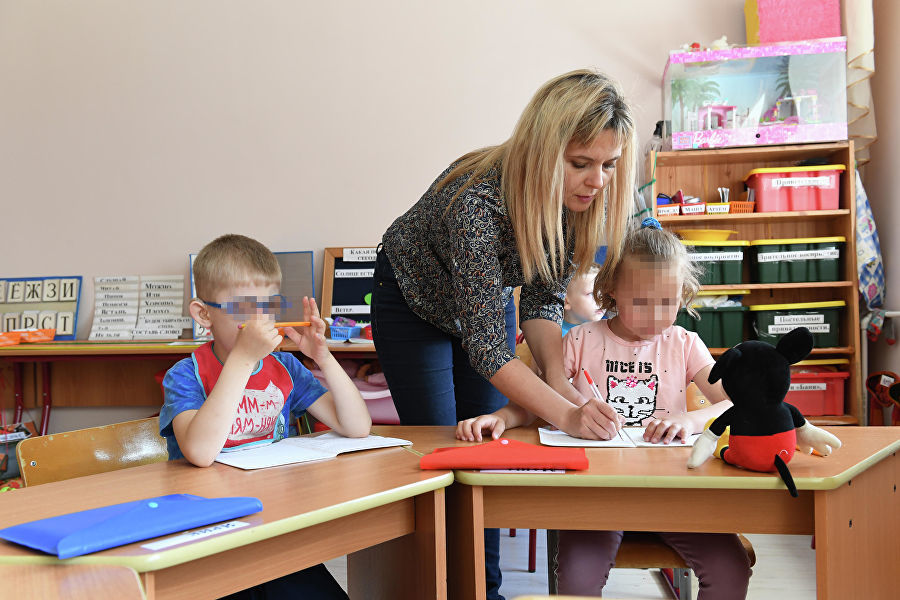
In the next room, four younger pupils write dictation. Two have handwriting devices for writing in Braille, the rest fill the paper in special machines that are very similar to typed ones, but have only six keys.
“Learning to write on the device is not so easy. Each letter in the Braille alphabet consists of six points that children squeeze out with a stylus. But before you knock out the letter, you need to present it upside down. Not all manage to do this. Those who find it difficult, type. There are only six keys on it, each of which represents a certain point, ”Svetlana Zarechnova, deputy director for educational work, describes the process.
“We had a concert yesterday,” the teacher dictates. Ira, a girl of nine, diligently presses the keys of a typewriter. Ira wears glasses with very thick glasses. But they are not able to make the girl see at least the outlines of objects. She is totally deaf from birth.
“Many of our pupils wear glasses, but they are only cosmetic, they correct the appearance of the eyes,” Zarechnova explains. - The fact is that with age the eyes of the blind are deformed, they look quite unaesthetic. To correct this defect, we register points. Also, the glasses protect the pupils from mechanical damage.
”
A year ago, Ira was implanted with a bone implant - now she hears separate sounds. However, it is very difficult to teach these children to recognize speech and then speak.
“A child after birth gradually learns to understand speech. At first, mom uses euphemisms in conversation with him: “am am” instead of “having lunch”, “Bibika” instead of a car. Over time, the baby learns more and more words, learns to distinguish speech from extraneous sounds. Now imagine: a deaf child put on the machine. The world came to life for him. But he does not understand what sounds in this stream are important, and what are not. We are learning to develop auditory perception so that the child can begin to speak, ”the director of the orphanage Galina Epifanova reveals the subtleties.
Not every graduate is able to do this. In the classroom for younger pupils, we get acquainted with Svyatoslav. The boy bent over the notebook, almost resting his nose on the table. True, the letters still "jump." “Svyatoslav is not totally blind, but his eyesight is very poor. Besides seeing only one eye. He has half of his face paralyzed, his mouth does not close, ”says the defectologist.
Because of this, apparently, the boy can never speak. But such complex children in the orphanage are taught all the everyday skills. For this, pupils are taken to home economics lessons from an early age.
“For example, how to teach a totally deaf-blind child to determine how much water is poured in a mug? By weight. And if it is boiling? - the boarding director gives an example. “It takes months for our students to master the most basic everyday skills.”
Galina Konstantinovna describes how the child is taught to distinguish between the grains. First, they are asked to disassemble the beans and peas mixed together by grain. When they cope, they get the smaller cereals - rice and barley. Then even smaller millet and buckwheat. "So we develop the tactile sensitivity of the hands."
“ They go home and forget what we taught them ”
Children from different cities of Russia come to Sergiev Posad boarding school. Queues have to wait for a year and a half. “Parents or guardians write to us. First, we call the child on the medical-psychological-pedagogical commission. If we understand that the diagnosis corresponds to our profile, we put in a queue, - explains Galina Konstantinovna. - Almost always for these children and their parents, our boarding school is the last hope. They simply don’t take them to others - they don’t know how to communicate with such children. ”
In Sergiev Posad, pupils may be up to 18 years old. If they continue training - then up to 21 years. Then they return to their villages - and over time they forget everything that they were taught here.
“This is especially a big problem for orphans. They return to small towns or even villages where they have to stay in apartments for years. There is no work for them there, the necessary infrastructure, too. Gradually, they forget everything that we taught them, become incapacitated and go to psycho-neurological boarding schools. ”
There is a way out of this vicious circle: in Sergiev Posad, it is planned to build a center for post-internatal escort, where graduates could live on their own, but under the strict guidance of former teachers. In addition to residential buildings, it is planned to equip workshops in the center in which graduates can work.
“While the construction is at the stage of excavation, they plan to finish it only in 2020. Naturally, up to this time, we try not to let our orphaned graduates home. Five were staged at the Kaluga rehabilitation and educational complex, one was sent to study in Reutov, where he mastered the profession of a cook. ”
But what will happen if the construction is delayed? Galina Konstantinovna is afraid to even think about it. Now 205 students study at the boarding school, 29 of them are orphans.